

Is Trump Abandoning Asia?
With the last U.S aircraft carrier pulled from Asia, questions arise over whether the U.S will protect its allies in the event of conflict.

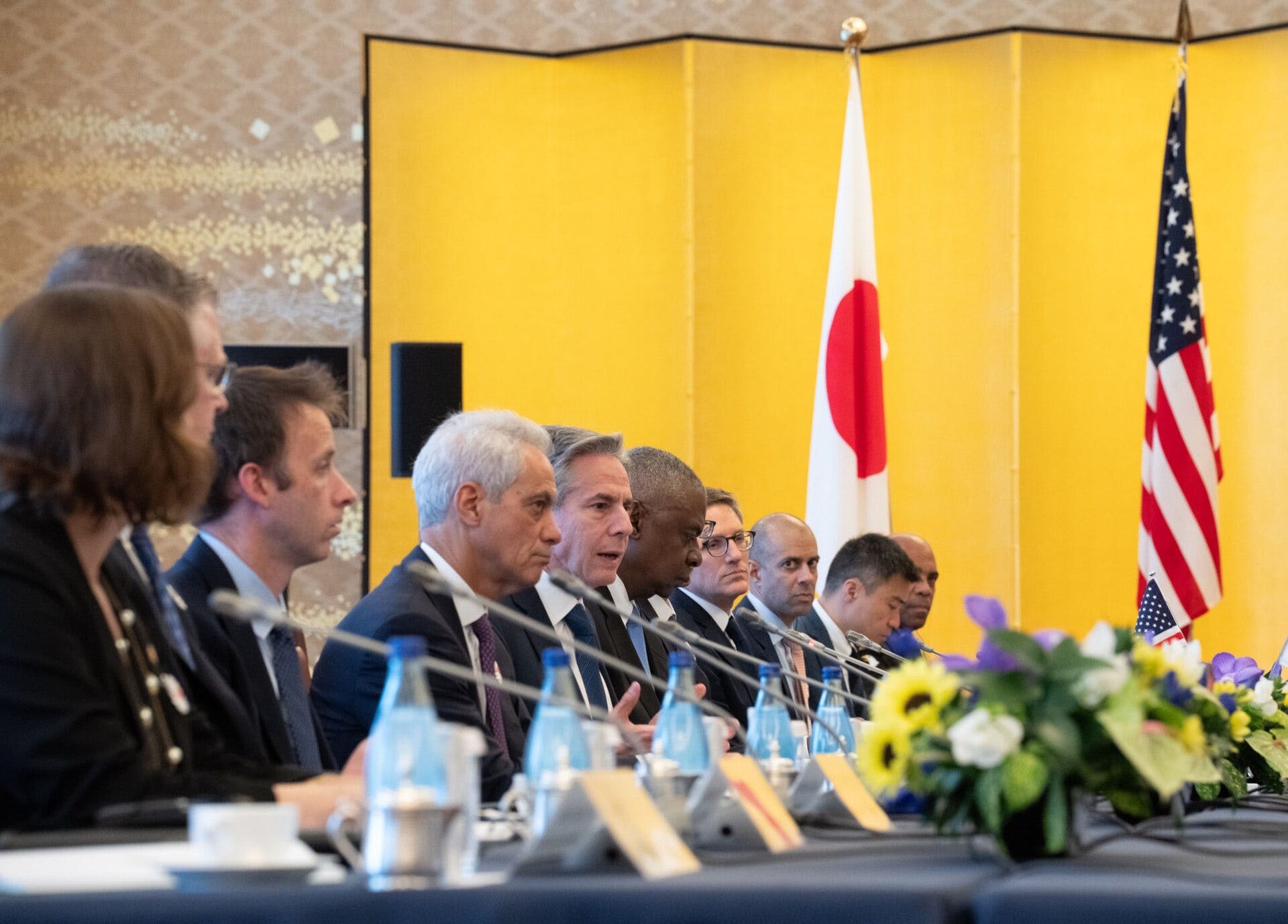
The U.S. has long made a promise to its allies in Asia that can be summed up as simply: “We will protect you if China attacks.” The growing expansionist activity of the Chinese government, alongside its rapid and aggressive military buildup, has alarmed nations across the Indo-Pacific and has given the United States reason to assist in return for economic cooperation.
That promise was mostly kept for decades. However, President Trump’s second administration is proving to take us in the opposite direction, undermining the American defense of the Indo-Pacific and diverting loose resources to unnecessary conflicts and wasteful activity rather than productive domestic affairs.
Dying Diplomacy
The U.S. State Department, the leading agency for international affairs, is the first victim of Trump’s cuts. Specifically, as part of an ongoing push for “America First” bureaucratic efficiency led by the White House and the Office of Management and Budget, the State Department notified Congress of plans to close several smaller diplomatic posts.
However, two of these posts were the U.S. consulates in Nagoya, Japan, and Medan, Indonesia. These posts were exceptionally small, with total projected savings across these and the other global closures estimated at roughly $4.4 million annually.
The administration claimed that these closures were a matter of necessary fiscal restraint and administrative streamlining to reduce an already-cluttered American bureaucracy. But critics and Democratic lawmakers argue that cutting diplomatic contact points in strategic areas such as Indonesia and with key partners like Japan sends a bad message.
Experts such as John Kiriakou have consistently stated that the current American foreign policy establishment either wastes our diplomatic resources or neglects their use entirely. The Trump administration's push to exacerbate this problem does not serve long-term American interests in any way.
Military Hopes and Dreams
The ongoing U.S.-Israel military campaign against Iran has also caused significant friction between Indo-Pacific priorities and actual resource allocation.
The U.S. Navy recently pulled its last aircraft carrier, the USS George Washington, out of Asia to rotate in for the USS Abraham Lincoln, which returns home soon after being at sea in the Middle East for 9 months (significantly longer than the administration initially projected). Leaving the Western Pacific without a premier aircraft carrier has now forced the U.S. into a zero-sum game with its naval assets.
The Iran conflict has been a particularly agitating point of contention between Trump’s administration and reality. It has overstretched resources, especially naval (in a failing bid to control the Strait of Hormuz) and has significantly driven up costs for the American economy. The premise of the conflict was preventing their nuclear development, but Iranian President Masoud Pezeshkian has stated over and over again that Iran does not intend to pursue nuclear armament.
If “America First” was the priority of the administration, even going so far as to delete diplomatic stations in key areas, then what is the Iran conflict supposed to be? As of now, Americans have seen virtually zero tangible benefit at home.
Two-Faced Policy
The Pentagon maintains that “great-power competition” with China is a top priority of American defense policy, but recent actions paint an entirely different picture.
At the moment, the public sees an administration that does not care about domestic consequences and wastes its resources pursuing foreign policy goals that ignore American interests. If American global primacy is to be maintained, the United States has to rediscover its “America First” roots and begin shifting its priorities.
But the Iran war has caused a rude awakening, and Washington is beginning to learn the fault of its current priorities. As the conflict continues to slash through old pipe dreams with reality, the optimistic outlook says that the establishment will finally allow the State Department to rebuild what was once the strongest diplomatic service in the world.
Impowering American diplomacy is the best way to proceed with healing the rifts that the administration has caused between us and our allies.